HIP & KNEE ARTHRITIS
Osteoarthritis, and what comes before surgery.
Osteoarthritis is the most common reason people need a hip or knee replacement. It is also the reason most people with hip or knee pain never need one.
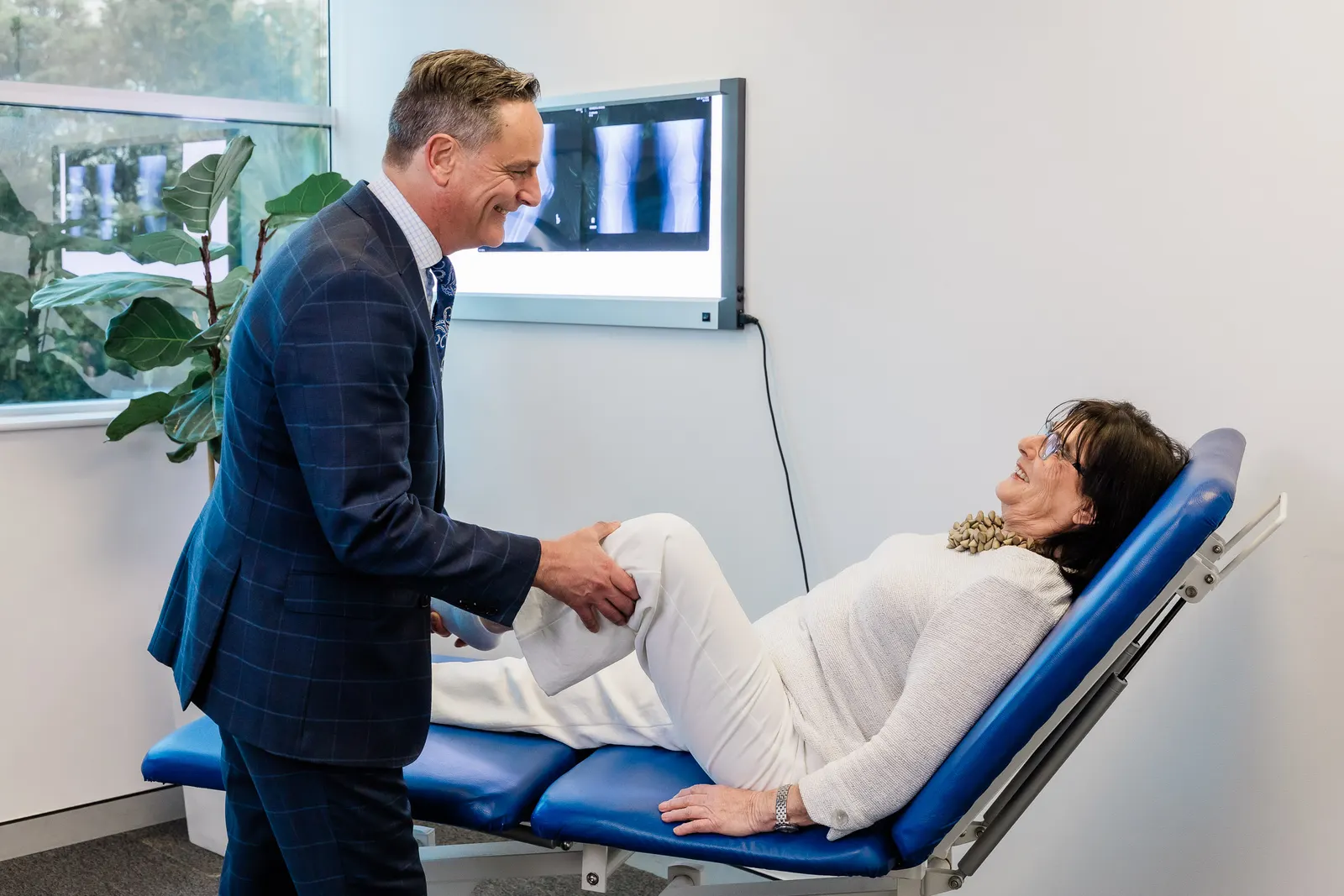
Overview
More than 2.1 million Australians live with osteoarthritis. In 2021–22 the Australian Institute of Health and Welfare recorded 53,500 knee replacements and 35,500 hip replacements performed to treat it — a large number, and still only a small fraction of the people living with the condition.
Surgery is one treatment for osteoarthritis and is generally considered only after appropriate non-operative care is no longer providing sufficient relief. Many people manage hip or knee osteoarthritis for years without needing an operation. Dr Limbers’ experience across more than 5,000+ hip and knee replacements informs both the decision to recommend surgery and the decision to continue non-surgical care.
What is osteoarthritis?
Osteoarthritis affects the whole joint, not just the cartilage.
The smooth surface that allows the bones to glide over one another gradually thins and roughens. The bone underneath changes and thickens, the lining of the joint can become inflamed, and the ligaments and muscles around the joint are affected.
The result is pain, stiffness, swelling and reduced movement, usually developing over years rather than months.
The older description of osteoarthritis as simple “wear and tear” is neither accurate nor helpful. It suggests the joint is being used up, and that activity makes it worse. Neither is true, and believing it leads people to stop moving — which reliably makes symptoms worse.
What causes it?
There is rarely a single cause. Contributing factors include:
- Age, though osteoarthritis is not an inevitable part of getting older
- Genetics and family history
- Previous injury to the joint, including fractures and ligament or meniscal injuries
- Previous surgery to the joint
- Carrying additional body weight, particularly for the knee
- Occupations or activities involving heavy repetitive loading
- Joint shape — hip dysplasia and femoroacetabular impingement both predispose to hip arthritis
- Inflammatory conditions such as rheumatoid arthritis
Symptoms of osteoarthritis
Knee osteoarthritis
- Pain on walking, stairs, and standing up from a chair
- Stiffness after sitting, or first thing in the morning
- Swelling around the knee
- Grinding or crunching in the joint
- The knee giving way, or feeling unreliable
- Bow-legged or knock-kneed deformity developing over time
- Night pain and disturbed sleep
- Reduced walking distance
Hip osteoarthritis
- Groin pain, often deep and aching — this is the classic site, not the outside of the hip
- Pain referred to the thigh or the knee
- Stiffness, particularly first thing in the morning
- Difficulty putting on shoes and socks, or cutting toenails
- Difficulty getting in and out of a car
- A limp
- Reduced walking distance
- Pain at night, and difficulty finding a comfortable position
Hip arthritis is regularly mistaken for a knee problem, because the pain refers down the thigh. It is not unusual for someone to be investigated for a knee complaint before the hip is identified as the cause. If your knee has been scanned and nothing much was found, the hip is worth examining.
How is it diagnosed?
Diagnosis rests on your symptoms and an examination, supported by X-rays taken while you are standing. Weight-bearing X-rays show the joint under load and give a far more accurate picture than films taken lying down.
An MRI is rarely needed to diagnose osteoarthritis. Finding a degenerate meniscal tear on an MRI of an arthritic knee is common and usually incidental — it is not, on its own, a reason for surgery.
Does the X-ray decide whether I need surgery?
No, and this matters more than almost anything else on this page.
The severity of arthritis on an X-ray correlates poorly with how much pain a person has and how much it limits them. Some people with severe changes on film manage well. Others with moderate changes cannot sleep, cannot work, and have stopped doing the things they care about.
The decision to operate is based on symptoms, function and how you have responded to non-operative treatment. The X-ray confirms the diagnosis and informs the plan. It does not make the decision.
What is recommended first?
The Australian Commission on Safety and Quality in Health Care sets out the foundation of osteoarthritis care in its Osteoarthritis of the Knee Clinical Care Standard: education and self-management, exercise, and weight management where relevant. These are recommended for everyone with osteoarthritis, at every stage — including people who go on to have surgery, and including people whose arthritis is advanced.
Exercise
Exercise is a core first-line treatment for hip and knee osteoarthritis. Strengthening the muscles around the joint can reduce pain and improve function, and appropriate exercise does not accelerate osteoarthritis.
The evidence supports both strengthening and general aerobic exercise:
- Stretching to maintain movement around the joint
- Targeted strengthening of the quadriceps, hamstrings and calf for the knee, and the gluteal muscles for the hip
- Low-impact aerobic exercise — walking, cycling, swimming
- Water-based exercise, which is useful for people who find land-based exercise too painful to begin with
What matters most is that it is done regularly and continued. The benefit fades when the exercise stops. A physiotherapist or exercise physiologist can build a program suited to your joint and your current level of function.
Weight management
Where a person is carrying additional weight, losing some of it reduces load through the hip and knee and reduces pain. The effect is dose-related — more weight loss produces more benefit — and it works best combined with exercise rather than instead of it.
This is raised because the evidence is clear, not to assign blame. Osteoarthritis has many causes, and plenty of people develop it at a perfectly healthy weight.
Mechanical support
- A walking stick, used in the hand opposite the affected joint, meaningfully reduces load through it
- Cushioned footwear or shock-absorbing insoles reduce impact
- A knee sleeve or brace can improve confidence and stability, and provides warmth
- Heat is useful for stiffness; cold can help a swollen, irritable joint
- Pacing and activity modification — changing how you do things, rather than stopping
Pain relief
Simple pain relief has a role, though its effects in osteoarthritis are modest.
- Topical anti-inflammatory gels are a reasonable first option for knee osteoarthritis, with fewer systemic effects than tablets
- Oral anti-inflammatory medicines can help, particularly for flare-ups, but carry risks to the stomach, kidneys and heart — discuss them with your GP, especially alongside other medications
- Paracetamol has limited benefit in osteoarthritis, though some people find it useful
- Opioid medicines are not recommended for osteoarthritis. The benefit is small, the harms are considerable, and long-term use before joint replacement is associated with worse outcomes afterwards
Your GP is the right person to manage this.
Injections
- Corticosteroid injections may be considered in selected patients with hip or knee osteoarthritis. Dr Limbers refers patients to radiology practices for image-guided intra-articular injections where appropriate. The response can be unreliable and is often short-lived, so an injection is generally used for temporary symptom relief rather than as a treatment for the underlying arthritis. If joint replacement is being considered, Dr Limbers advises that hip or knee replacement should not be performed within three months of an intra-articular injection because of the associated infection risk.
- Hyaluronic acid and platelet-rich plasma (PRP) injections can lead to short-lived symptom reduction in some patients with milder hip or knee osteoarthritis, although the response varies and these treatments do not reverse the underlying arthritis. Stem-cell treatment does not currently have an established role in the treatment of hip or knee osteoarthritis.
Dr Limbers does not use a single preferred physiotherapy or exercise-physiology pathway. Where appropriate, he refers patients to a physiotherapist or exercise physiologist for an individualised exercise and strengthening program.
What is not recommended?
Keyhole surgery (arthroscopy) is not recommended as a treatment for osteoarthritis of the knee. This is the settled position of Choosing Wisely Australia, the Royal Australian College of General Practitioners and the Australian Commission on Safety and Quality in Health Care. Trials have repeatedly shown no meaningful benefit over non-surgical care for arthritic knees, including where a degenerate meniscal tear is visible on the scan.
It is stated here because it is still commonly asked about, and because knowing what does not work is as useful as knowing what does.
When is joint replacement considered?
Joint replacement is considered when the combination of pain, stiffness and lost function remains substantial despite appropriate non-operative treatment, and when it is affecting your quality of life.
The questions that matter in that conversation are practical ones:
- What can you no longer do that you would like to be able to do?
- Is pain disturbing your sleep?
- How far can you walk before you have to stop?
- Have exercise, weight management and pain relief been genuinely tried?
- What are the risks in your particular case, given your general health?
There is no fixed age threshold and no point at which surgery becomes compulsory. It is a decision made with you, not for you.
Key operations performed
Point of difference
Why patients see Dr Limbers about arthritis.
Assessment based on symptoms and function, not on the appearance of the X-ray alone
Non-operative management discussed properly before surgery is recommended
A practice confined to hip and knee arthritis, so the assessment is the whole focus rather than a sideline
More than 5,000+ hip and knee replacements over a 25+ year career, informing the judgement of when surgery is and is not appropriate
One of Australia’s largest individual case series of Mako robotic hip and knee replacement

Key orthopaedic surgical experience
Dr Limbers’ practice is confined to hip and knee arthritis and joint replacement, and a substantial part of it is assessment rather than surgery. He reviews the severity of arthritis, its effect on quality of life and the response to non-operative care before discussing whether joint replacement is appropriate. Patients are frequently advised that surgery is not yet warranted and are given a plan for non-operative care instead. Dr Limbers’ experience across the full spectrum of hip and knee arthritis helps inform the judgement of when joint replacement is likely to be worthwhile — and when continued non-surgical treatment is more appropriate.
Read moreRead less
Common questions
Osteoarthritis, answered.
Will exercise wear my joint out faster?
No. Appropriate exercise does not accelerate osteoarthritis, and strengthening the muscles around the joint reduces pain and improves function. Avoiding movement leads to weakness and stiffness, which makes symptoms worse.
My X-ray says “bone on bone” — do I need surgery?
Not necessarily. The severity of arthritis on an X-ray correlates poorly with symptoms and function. The decision to operate is based on how much pain and limitation you have, and how you have responded to non-operative treatment.
Why does my hip pain feel like it is in my knee?
Hip arthritis commonly refers pain down the thigh to the knee. It is one of the more frequent reasons a hip problem is investigated as a knee problem first. An examination of the hip usually settles it quickly.
Should I have keyhole surgery for my arthritic knee?
Arthroscopy is not recommended as a treatment for knee osteoarthritis. Australian guidance is consistent on this, including where a degenerate meniscal tear is seen on a scan.
Is it better to wait as long as possible before having a joint replacement?
Not as a rule. There is no universal benefit in delaying surgery for as long as possible, but nor is there a fixed point at which an operation becomes necessary. Timing is individual and depends on pain, function, general health, the response to non-operative treatment and the effect arthritis is having on your life.
Do stem-cell or PRP injections work for arthritis?
PRP and hyaluronic acid injections may provide short-lived symptom reduction in some patients with milder hip or knee osteoarthritis, although the response is variable and they do not reverse the underlying arthritis. There is currently no established role for stem-cell treatment in hip or knee osteoarthritis.
Do I need a referral to be assessed?
A referral is not legally required to see a specialist, but the practice requests a current referral before your appointment. A valid referral is also required to claim a Medicare rebate.
Last reviewed October 2026
Sources5 references
- Australian Commission on Safety and Quality in Health Care; Osteoarthritis of the Knee Clinical Care Standard: https://www.safetyandquality.gov.au
- Royal Australian College of General Practitioners; Guideline for the management of knee and hip osteoarthritis: https://www.racgp.org.au
- Australian Institute of Health and Welfare (AIHW); Osteoarthritis: https://www.aihw.gov.au/reports/musculoskeletal-conditions/osteoarthritis
- Choosing Wisely Australia: https://www.choosingwisely.org.au
- Healthdirect; Osteoarthritis: https://www.healthdirect.gov.au/osteoarthritis
Book an Appointment Today
If hip or knee pain is impacting your quality of life, Dr Limbers can assess whether joint replacement or another treatment option is appropriate for you.
Appointments are available at Wahroonga on the North Shore, and at North Gosford and Kanwal on the Central Coast. A current referral is generally requested and allows eligible Medicare patients to claim the relevant rebate.