Mako assisted
Total knee replacement.
Mako total knee replacement is a robotic-arm assisted procedure for patients whose knee has been extensively damaged, most commonly by osteoarthritis. The worn joint surfaces are removed and replaced with metal and polyethylene components designed to reduce pain and restore useful movement.
Overview
Knee replacement is the most commonly performed joint replacement operations in Australia. The Australian Institute of Health and Welfare recorded 53,500 knee replacements performed for osteoarthritis in 2021–22.
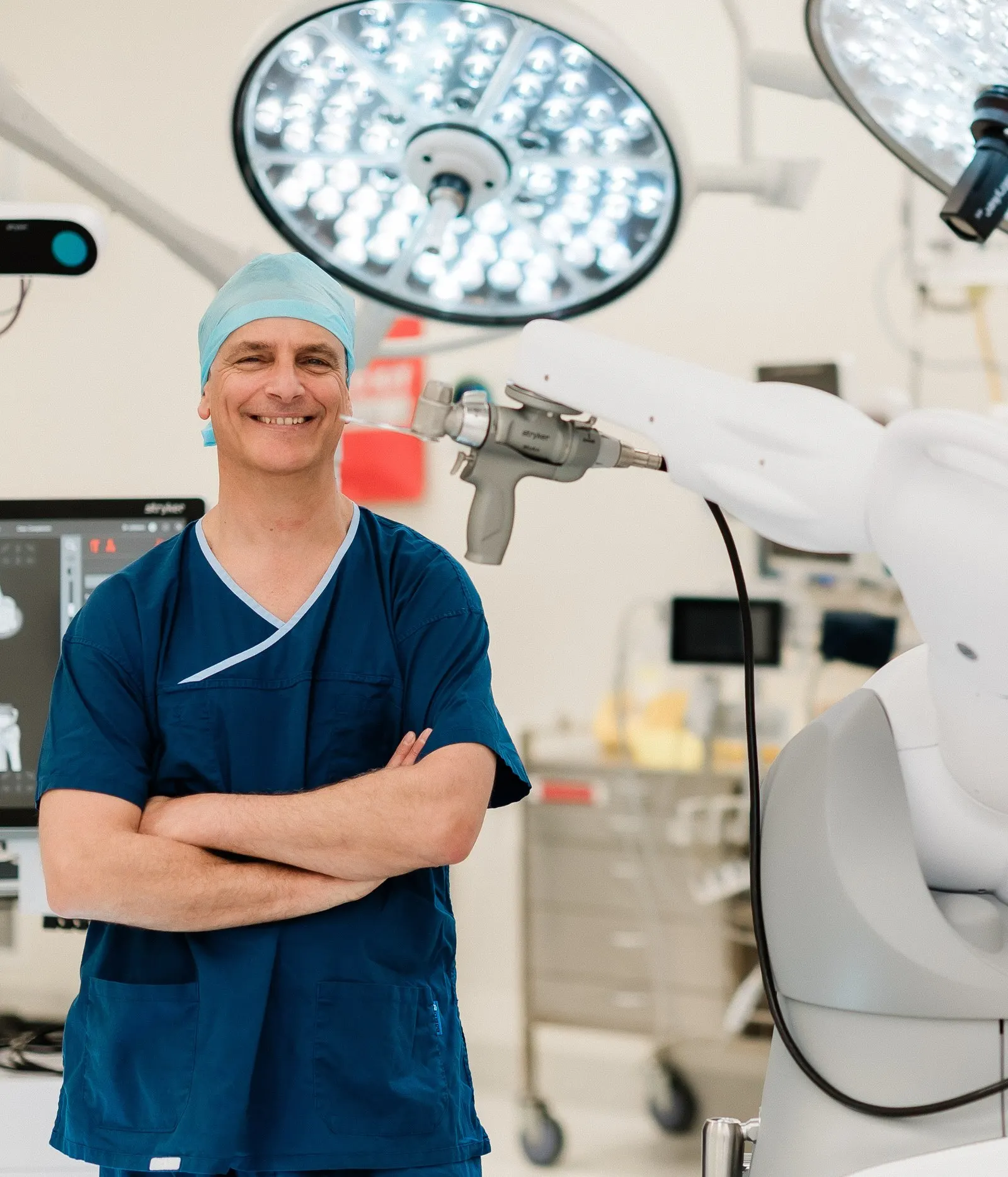
Dr John Limbers was the first surgeon in New South Wales to perform a Mako robotic total knee replacement outside the technology’s pre-release clinical assessments, and contributed to the RASKAL trial that tested whether robotic assistance actually improves the result.
Most people arrive at the decision slowly. Knee arthritis progresses over years, and people adapt around it — walking less, avoiding stairs, giving up activities — until the adaptations stop working or sleep is affected.
Mako total knee replacement is a robotic-arm assisted procedure for patients whose knee has been extensively damaged, most commonly by osteoarthritis. The worn joint surfaces are removed and replaced with metal and polyethylene components designed to reduce pain and restore useful movement.
When is total knee replacement considered?
Total knee replacement may be considered when arthritis affects multiple parts of the knee and symptoms remain significant despite appropriate non-operative treatment. Common reasons for referral include persistent pain, stiffness, disturbed sleep, reduced walking tolerance and difficulty with stairs, work, exercise or everyday activities.
The decision is based on symptoms and function as well as imaging. The presence of arthritis on an X-ray alone does not mean knee replacement is required.
The Osteoarthritis of the Knee Clinical Care Standard sets out non-surgical management — exercise, weight management where relevant, and pain management — as the foundation of care, with surgery considered when those measures no longer provide adequate relief.
What are the symptoms of knee arthritis?
- Pain on walking, stairs, and standing up from a chair
- Stiffness, particularly after sitting or first thing in the morning
- Swelling
- Grinding or crunching in the joint
- The knee giving way
- Bow-legged or knock-kneed deformity developing over time
- Night pain and disturbed sleep
- Reduced walking distance
What happens before surgery?
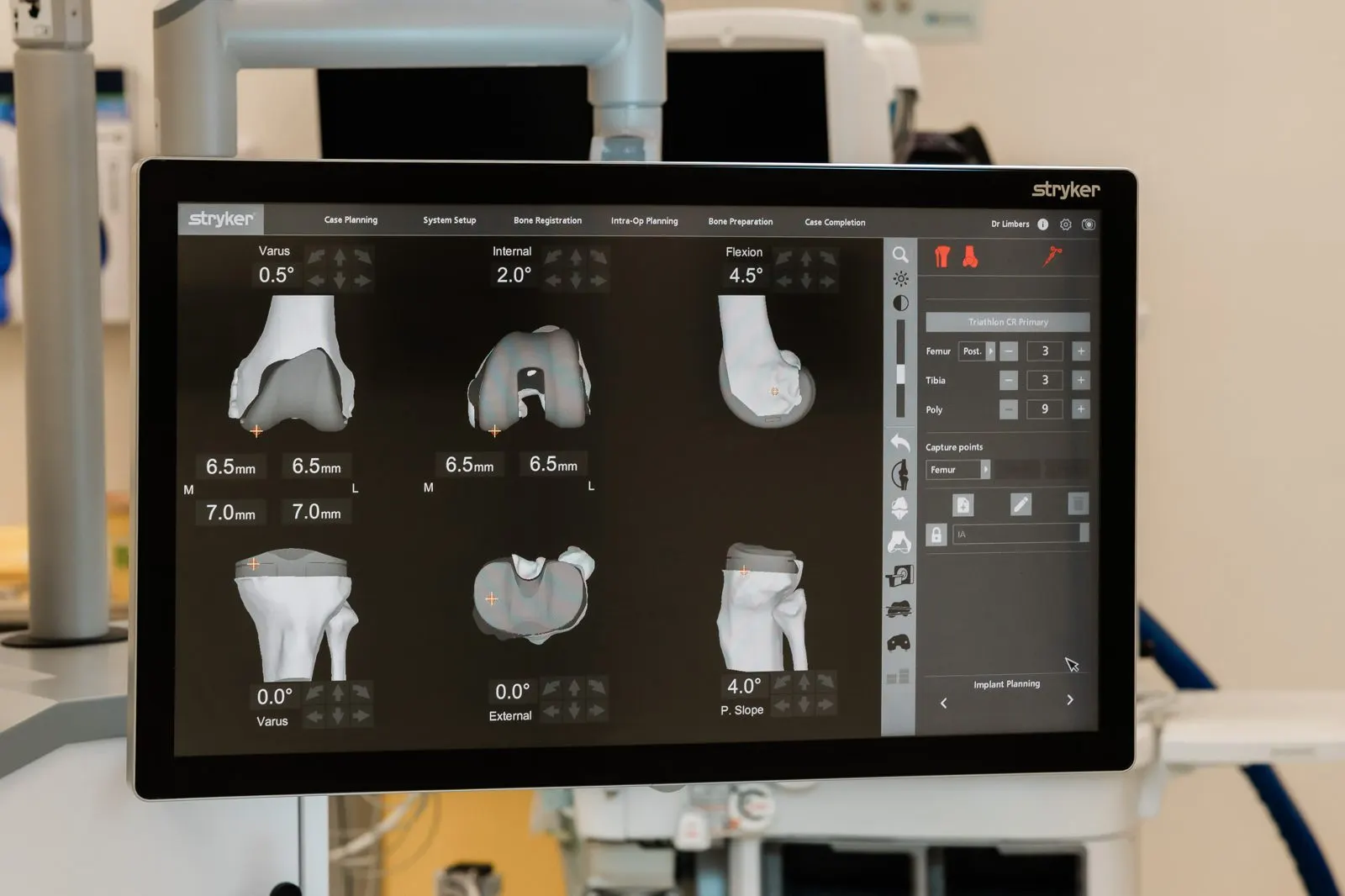
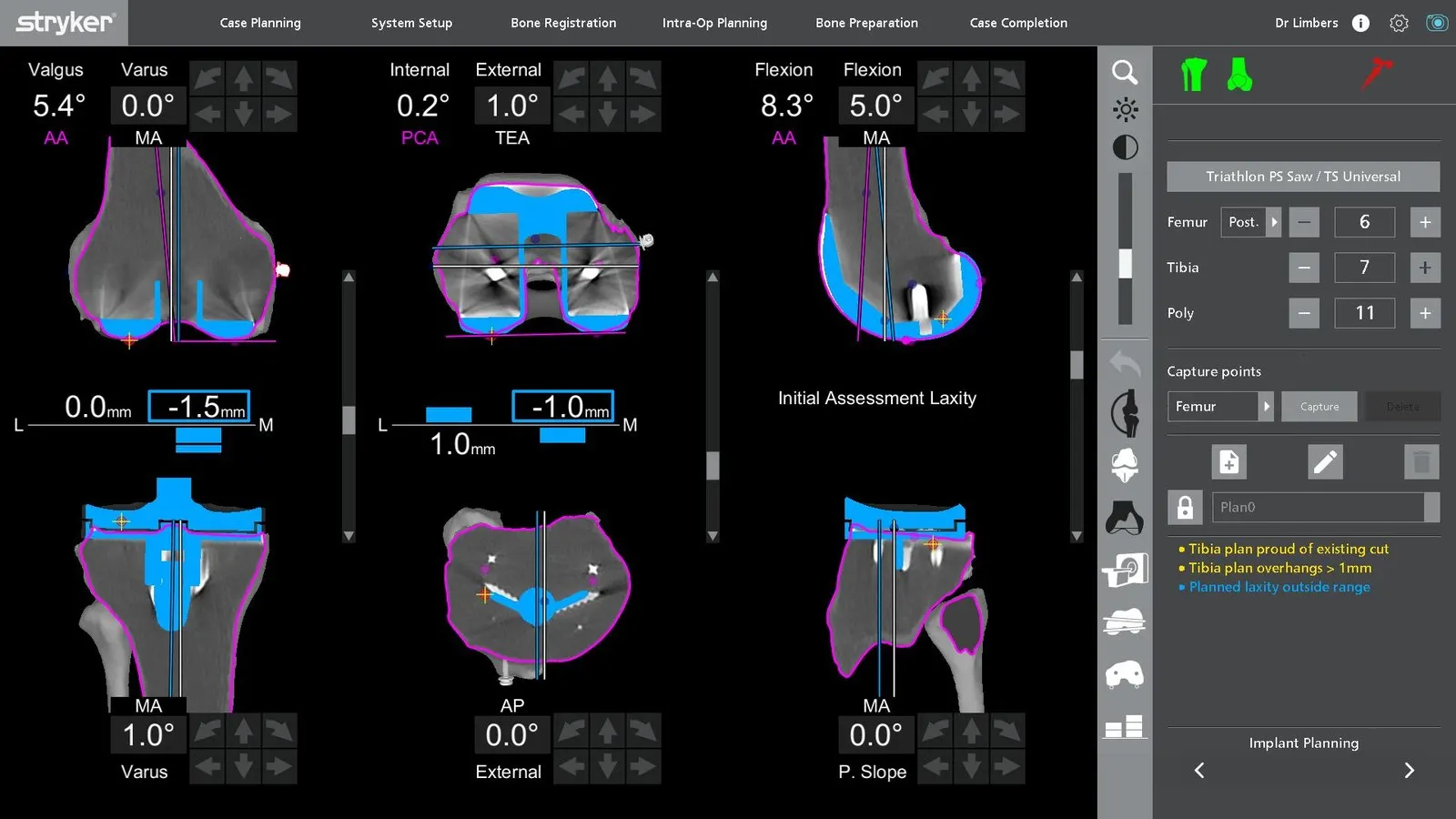
A CT scan is performed using a Mako-specific protocol and used to create a three-dimensional model of the knee and develop a patient-specific surgical plan. Dr Limbers reviews the anatomy, proposed implant size and position, alignment and the amount of bone to be removed.
You may also require standard X-rays, blood tests, medical assessment and other investigations. General health, medications, home support and rehabilitation planning are reviewed before the operation.
How is knee alignment and balance planned?
A knee replacement must be positioned accurately and function in harmony with the surrounding ligaments and muscles. During surgery, Dr Limbers assesses knee movement and ligament tension, and the implant plan can be adjusted before any bone is prepared — which is where much of the practical value of robotic assistance lies.
This individualised process is sometimes described as functional or kinematic planning. The approach is selected according to your anatomy, deformity, ligament condition and surgical requirements.
How is the procedure performed?
After the knee is exposed, reference points are placed and your anatomy is registered with the Mako system. Dr Limbers checks the pre-operative plan against the information obtained in theatre and makes any required adjustments.
The robotic arm then assists with bone preparation within the planned boundaries, providing feedback and limiting the saw to the defined area. Trial components are inserted and the knee is assessed for movement, stability, alignment and soft-tissue balance before the final components are implanted.
Dr Limbers uses a lateral skin incision for total knee replacement, positioned towards the outer side of the knee rather than directly over the front. This is intended to avoid a central scar over the kneeling surface, allowing more comfortable kneeling after knee replacement surgery. Individual anatomy or previous surgery may require a different approach.
How is robotic knee replacement different from conventional surgery?
Both operations replace the same joint surfaces with the same types of implant. The difference is in how the plan is made and executed.
Conventional knee replacement uses mechanical instruments and intraoperative judgement to set implant position and alignment. Robotic assistance adds a CT-based patient-specific plan, the ability to assess soft-tissue balance and adjust the plan before cutting bone, and constrained bone preparation within that plan.
Compared with traditional manual instrumentation, robotic assistance improves the accuracy and consistency of implant positioning and constrains bone preparation to the planned area. Some studies report less pain or faster functional recovery in the early post-operative period, although these findings are not uniform and do not guarantee a better result for an individual patient.
The longer-term picture is still being established. The RASKAL trial, to which Dr Limbers contributed, compared robotic-assisted surgery with computer-navigated total knee replacement over two years. It found no significant difference in patient-reported or functional outcomes at two years. Robotic assistance was associated with shorter operating time and better preservation of the posterior cruciate ligament, while functional alignment reduced the need for soft-tissue releases. Longer follow-up is needed to determine whether these technical differences affect implant survival or revision rates.
What is the hospital stay and early recovery like?
Patients are generally encouraged to stand and walk soon after surgery with assistance from the hospital physiotherapy team. Pain relief uses a multimodal approach, and local anaesthetic is placed around the knee during surgery.
Length of stay varies according to mobility, pain control, medical health and home support. Early rehabilitation focuses on reducing swelling, regaining quadriceps control, restoring knee extension and flexion, and increasing walking distance.
Improvement is usually gradual. The greatest change commonly occurs over the first six weeks, although strength, endurance, swelling and confidence may continue to improve over several months.
What are the risks?
Potential risks include infection, blood clots, bleeding, stiffness, ongoing pain, nerve or blood vessel injury, fracture, instability, implant wear, loosening, anaesthetic complications and the possibility of further surgery.
Some patients continue to notice the knee replacement during particular activities, and full movement cannot be guaranteed. It is also worth knowing that a proportion of patients remain dissatisfied after knee replacement despite a technically sound operation — this is well documented and is one reason the decision to operate should not be rushed.
Your recovery
A typical timeline.
Day of surgery
Patients are generally encouraged to stand and walk soon after surgery with assistance from the hospital physiotherapy team. Local anaesthetic is placed around the knee during surgery.
Hospital stay
Length of stay varies according to mobility, pain control, medical health and home support. Early rehabilitation focuses on reducing swelling, regaining quadriceps control, restoring knee extension and flexion, and increasing walking distance.
3 weeks
Driving is typically possible at 3 weeks, but this varies from patient to patient — only once you can brake and accelerate confidently and are not affected by medications causing drowsiness.
6 weeks
Improvement is usually gradual. The greatest change commonly occurs over the first six weeks.
Several months
Strength, endurance, swelling and confidence may continue to improve over several months.
The evidence
What does the evidence show?
92%
of total knee replacements had not required revision at 20 years
in practical terms, from the 2025 AOANJRR 20-year cumulative revision rate of 8.0% for osteoarthritis. Individual longevity varies.
Compared with traditional manual instrumentation, robotic assistance improves the accuracy and consistency of implant positioning and constrains bone preparation to the planned area. Some studies report less pain or faster functional recovery in the early post-operative period, although these findings are not uniform and do not guarantee a better result for an individual patient.
The longer-term picture is still being established. The RASKAL trial, to which Dr Limbers contributed, compared robotic-assisted surgery with computer-navigated total knee replacement over two years. It found no significant difference in patient-reported or functional outcomes at two years. Robotic assistance was associated with shorter operating time and better preservation of the posterior cruciate ligament, while functional alignment reduced the need for soft-tissue releases. Longer follow-up is needed to determine whether these technical differences affect implant survival or revision rates.
Point of difference
Why Dr Limbers for total knee replacement.
Total knee replacement performed with Mako robotic assistance
Lateral skin incision, intended to avoid a scar over the kneeling surface and allow more comfortable kneeling
First surgeon in New South Wales to perform a Mako robotic total knee replacement outside pre-release clinical assessments
Contributor to the RASKAL trial of robotic-assisted knee replacement
More than 5,000+ hip and knee replacements over a 25+ year career
Key orthopaedic surgical experience
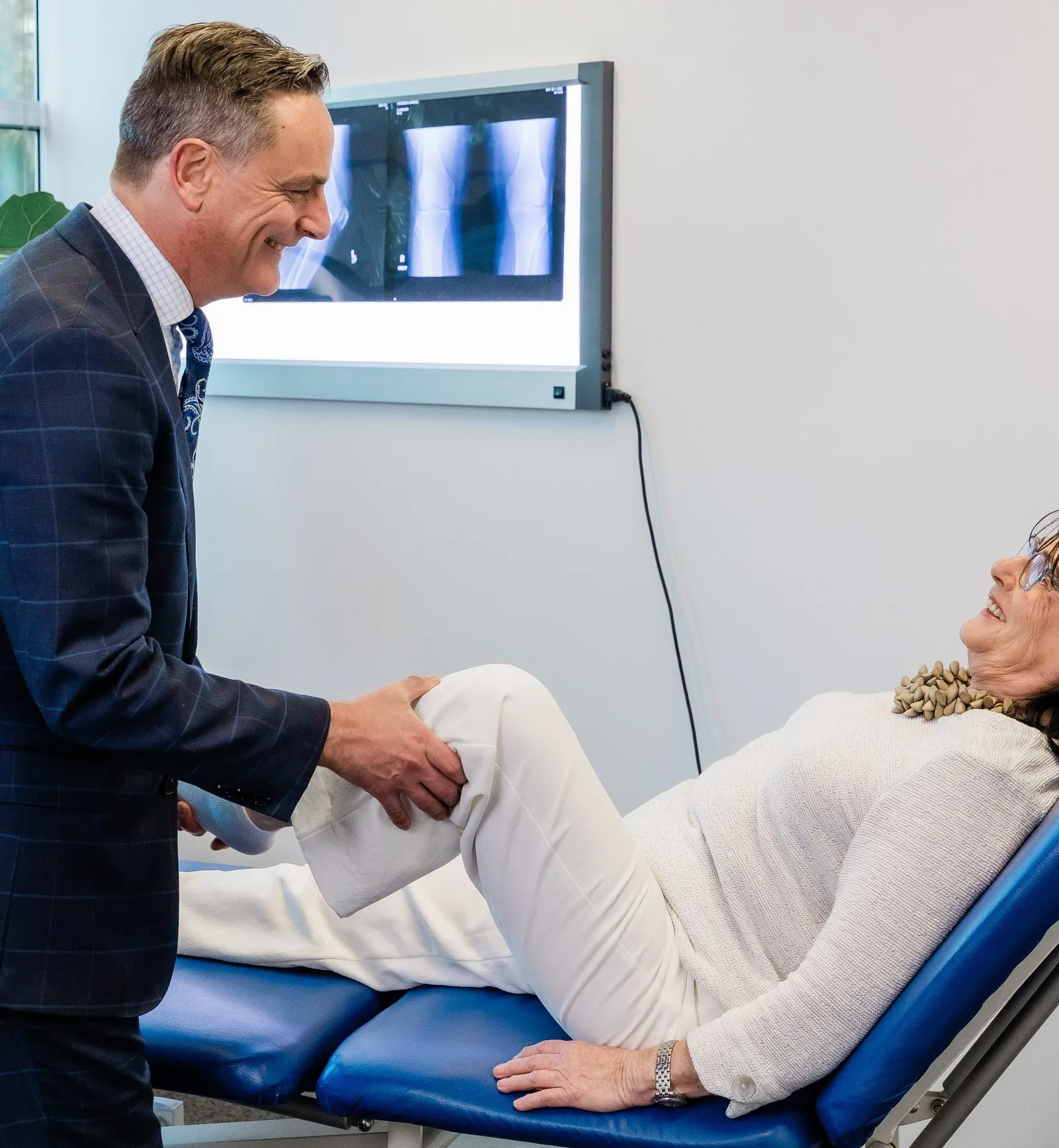
Dr Limbers was the first surgeon in New South Wales to perform a Mako robotic total knee replacement outside pre-release clinical assessments, and has used the system for knee replacement since its early availability in Australia. He contributed to the RASKAL registry-nested randomised trial examining robotic-assisted surgery and functional alignment in total knee replacement.
Read moreRead less
Common questions
Total knee replacement, answered.
Can I kneel after a total knee replacement?
Yes. Dr Limbers places the incision on the outer side of the knee to avoid the scar and numbness over the front of the knee, thus allowing more comfortable kneeling.
How long will a knee replacement last?
Australian registry data are more useful than a simple “15 to 20 years” estimate. The 2025 Australian Orthopaedic Association National Joint Replacement Registry (AOANJRR) reports a 20-year cumulative revision rate of 8.0% for total knee prostheses still in use in 2024 for osteoarthritis. In practical terms, about 92% had not required revision at 20 years. Individual longevity varies with age, activity, implant design and other patient factors, and younger patients have a higher lifetime chance of needing revision.
When can I drive after knee replacement?
Typically at 3 weeks, but this varies from patient to patient. They must be able to break and accelerate confidently and not be affected by medications causing drowsiness.
Will I need my other knee replaced?
Not necessarily. However, many cases of osteoarthritis are due to genetic factors that will affect the opposite knee at a later time.
Does robotic assistance guarantee a better result?
No surgical technology can guarantee a particular outcome. Mako assists with planning and accurate execution, but results also depend on diagnosis, anatomy, general health, rehabilitation and other individual factors.
Last reviewed October 2026
Sources5 references
- Australian Institute of Health and Welfare (AIHW); Osteoarthritis: https://www.aihw.gov.au/reports/musculoskeletal-conditions/osteoarthritis
- Australian Orthopaedic Association National Joint Replacement Registry (AOANJRR): https://aoanjrr.sahmri.com
- Australian Commission on Safety and Quality in Health Care; Osteoarthritis of the Knee Clinical Care Standard: https://www.safetyandquality.gov.au
- MacDessi SJ, et al. and the RASKAL Study Group. Bone & Joint Journal. 2026;108-B(5):622–633.
- Healthdirect; Knee replacement: https://www.healthdirect.gov.au/knee-replacement
Book an Appointment Today
If hip or knee pain is impacting your quality of life, Dr Limbers can assess whether joint replacement or another treatment option is appropriate for you.
Appointments are available at Wahroonga on the North Shore, and at North Gosford and Kanwal on the Central Coast. A current referral is generally requested and allows eligible Medicare patients to claim the relevant rebate.