REHABILITATION PROTOCOL
Recovery after partial knee replacement.
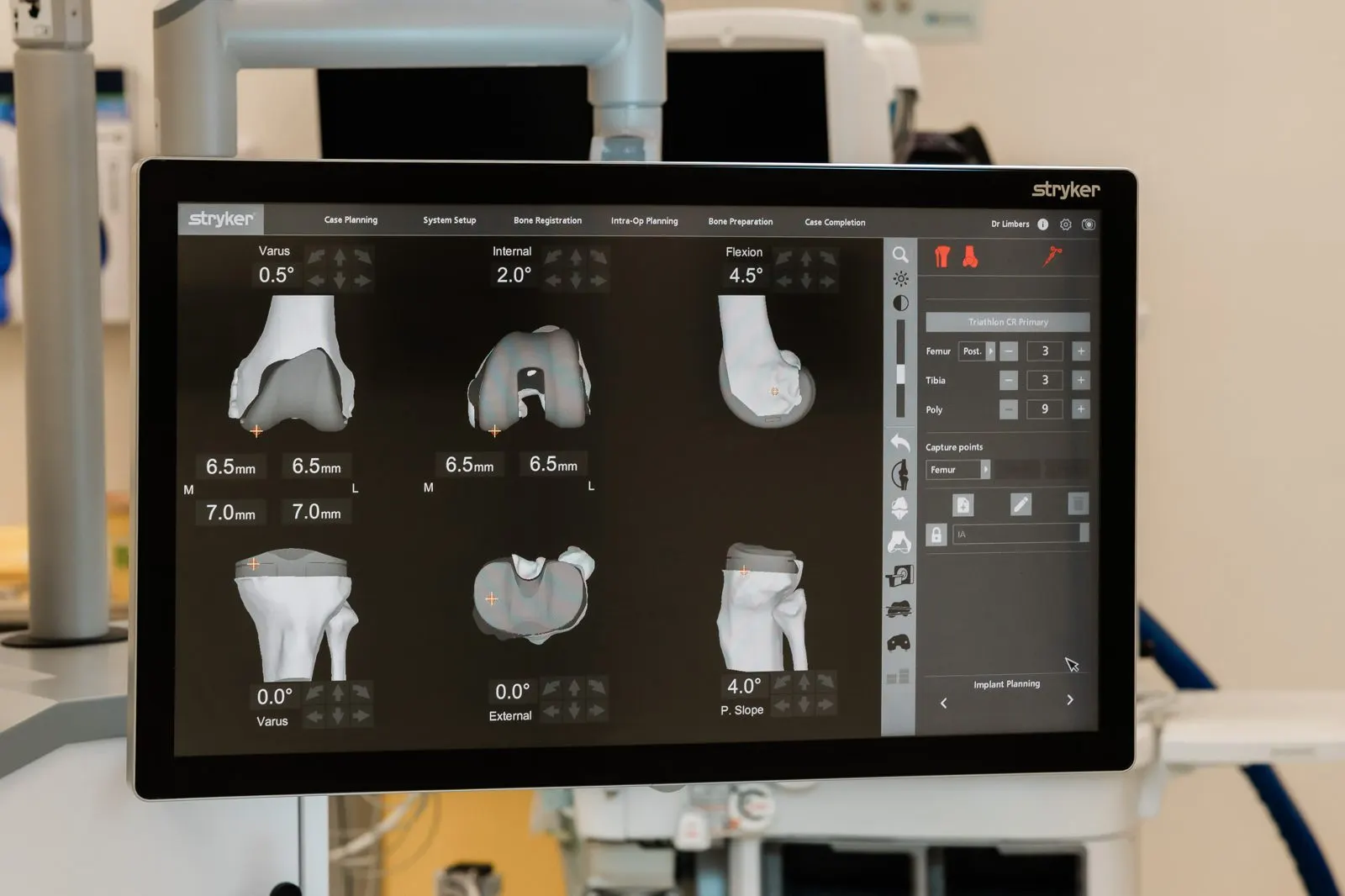
Rehabilitation after Mako partial knee replacement follows the same broad early principles as total knee replacement, but recovery progresses more quickly. The program should still be adjusted for pain, swelling, wound healing, quadriceps control and individual function.
Overview
Individual instructions from Dr Limbers or your treating physiotherapist take priority.
Recovery process
Weeks 0–2
Focus on quadriceps activation, full knee extension, progressive knee flexion, swelling control and safe walking.
- Isometric quadriceps, inner-range quadriceps, straight-leg raises and heel slides
- Seated knee extension and knee flexion
- Heel raises, mini squats and gentle lunges at a stable support
- Gradually increase walking on flat, firm surfaces
- Hydrotherapy may commence after day five with the dressing intact, where approved
Weeks 2–4
Progress repetitions and functional exercises. Add step-ups, controlled step-downs, balance exercises and light resistance where advised. Walking aids may be reduced once gait is safe and controlled.
Weeks 4–6
Continue to progress knee range, strength, balance, walking distance and low-impact cardiovascular exercise. An exercise bike and deeper squats may be introduced where comfortable and approved.
Managing pain and swelling
Swelling around the knee is expected and may persist for several months, often worse at the end of the day and after activity. Warmth around the knee is also normal for some weeks.
Elevation and ice as directed help. Take pain relief as prescribed, particularly before physiotherapy.
Returning to normal activities
Driving is typically possible at around three weeks, provided you can brake and accelerate confidently and are not affected by medication causing drowsiness. If you have concerns during business hours, contact Dr Limbers’ rooms by phone or email; outside business hours, contact the ward at the hospital where your procedure was performed. A follow-up appointment with a repeat X-ray is arranged at six weeks, with any further review organised at that stage.
Return to desk work can be often be undertaken from home after 2-3 weeks, with a return to the office at 6 weeks. Manual work, swimming, cycling and golf can commence at 6 weeks. Flying can be undertaken from 6 weeks.
Running and impact sport can be undertaken cautiously, although they do carry some risk of earlier joint replacement failure due to fracture and wearing of the joint replacement.
Dental work should be deferred for 6 weeks following joint replacement if possible. Your dentist or GP should provide you with a single dose of oral antibiotics (normally Amoxycillin 1 gram orally) approximately 30 minutes before the dental procedure.
Kneeling can be undertaken at any stage after partial knee replacement. In practical terms the patient will need enough flexion range and enough muscle strength to be able to kneel and get back up again. This will vary widely from patient, but may be 3 months following surgery.
Last reviewed October 2026
Book an Appointment Today
If hip or knee pain is impacting your quality of life, Dr Limbers can assess whether joint replacement or another treatment option is appropriate for you.
Appointments are available at Wahroonga on the North Shore, and at North Gosford and Kanwal on the Central Coast. A current referral is generally requested and allows eligible Medicare patients to claim the relevant rebate.