Mako assisted
Revision total hip replacement.
Revision hip replacement is performed when part or all of an existing hip replacement needs to be removed and reconstructed.
Overview
It is a more demanding operation than a first hip replacement. Previous surgery may have altered the anatomy, and there may be bone loss, scar tissue or damaged soft tissue to contend with. The implants are more complex, the planning matters more, and there is less margin for error.
Most hip replacements last a very long time, and most people never need a revision procedure. But implants can loosen, wear, become infected, dislocate repeatedly or be affected by a fracture — and when that happens, revision surgery may be required.
Dr John Limbers’ fellowship training was undertaken at Addenbrooke’s University Hospital in Cambridge and Cappagh National Orthopaedic Hospital in Dublin, two high-volume centres where complex and revision hip work is concentrated. Revision surgery has remained part of his practice since.
Is a painful hip replacement always a failing one?
No, and this is worth saying early.
Pain around a hip replacement can come from the spine, from the tendons on the outside of the hip, from the pelvis, or from a medical condition entirely unrelated to the joint. Revision surgery performed without a clear diagnosis frequently does not solve the problem, and it carries higher risks than the original operation.
The first priority is to establish why the hip hurts. Where a correctable problem with the replacement is identified, revision surgery may be appropriate. Where the cause remains uncertain, further investigation is generally preferable to proceeding with another operation.
Why might a hip replacement need revising?
- Loosening of the acetabular or femoral component
- Wear of the bearing surfaces
- Recurrent dislocation or instability
- Infection around the hip replacement
- Fracture around the implant
- Implant breakage or mechanical failure
- Adverse reaction to implant wear products
- Progressive bone loss
- Leg-length, offset or component-position problems where revision is clinically justified
Wear particles can also trigger a reaction causing the body to resorb bone around the implant, called osteolysis. It is often painless in its early stages, which is why long-term follow-up of a hip replacement matters.
What symptoms should be assessed?
- New or increasing pain in the groin, thigh or buttock
- Pain on standing or starting to walk
- A sense of instability, or the hip giving way
- Repeated dislocations
- A change in leg length
- Swelling, warmth or redness around the hip
- Wound discharge, at any time after surgery
- A grinding, clicking or squeaking sensation
How is it assessed and planned?
Assessment includes review of symptoms, previous operations, implant information, X-rays and the condition of the surrounding bone. Further investigations may include CT, blood tests, joint aspiration or nuclear imaging.
Revision planning must anticipate how existing components will be removed, the amount and location of bone loss, and which specialised implants may be required.
What does the procedure involve?
Depending on the problem, revision surgery may involve replacing only the socket, only the femoral component, the bearing surfaces, or the entire hip replacement. Failed components are removed carefully and bone loss reconstructed using revision shells, stems, screws, augments, graft or other specialised implants.
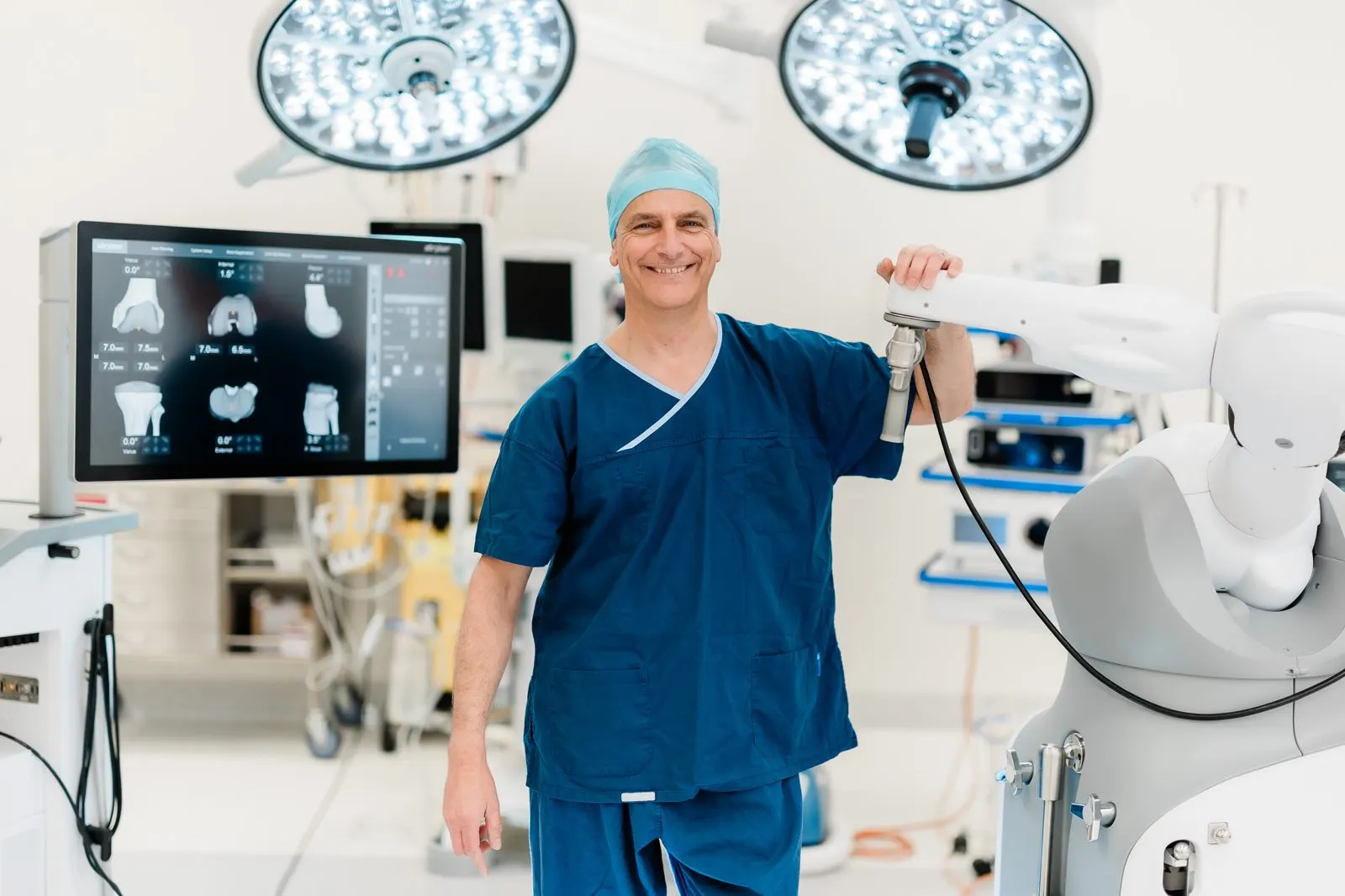
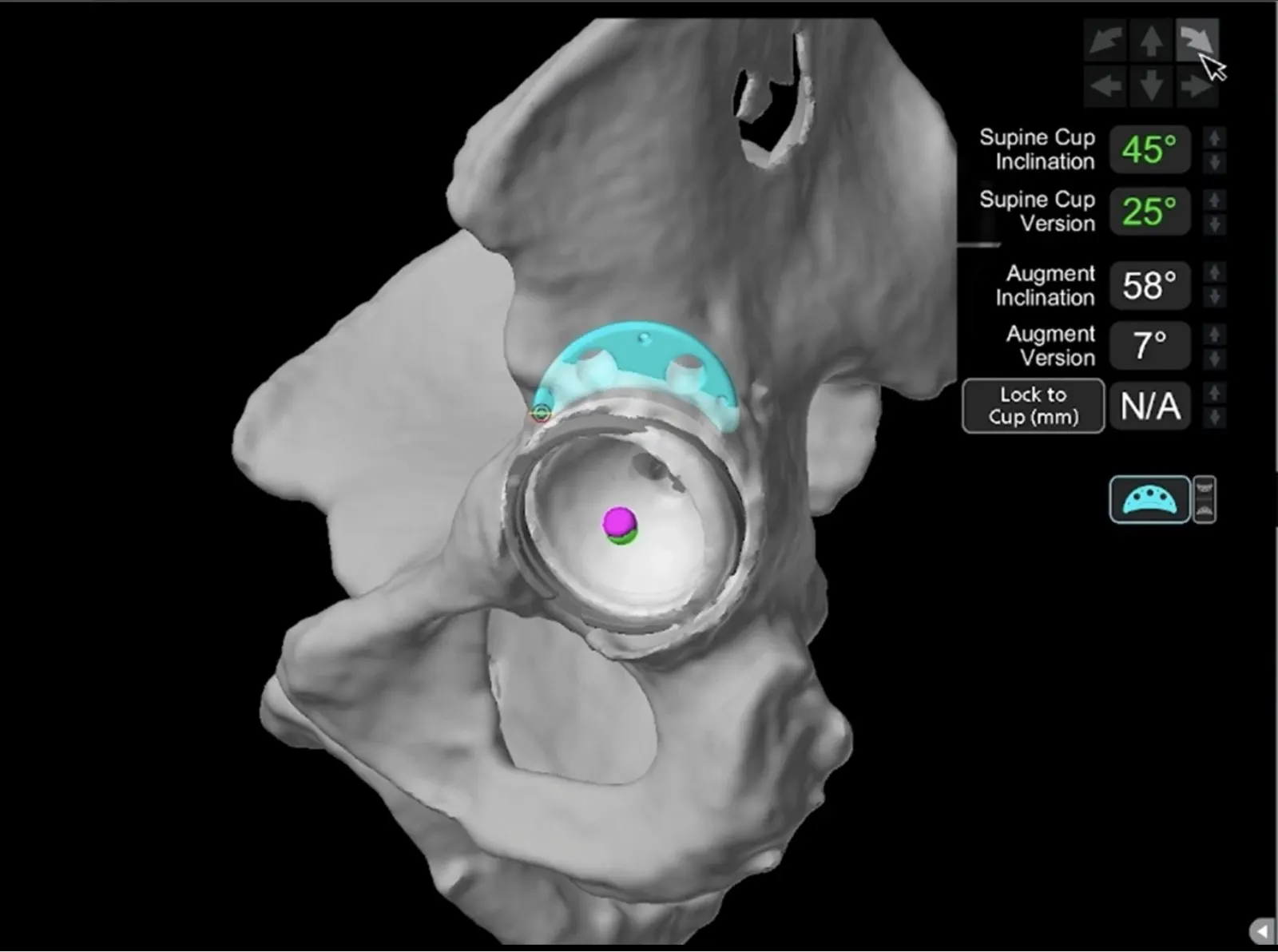
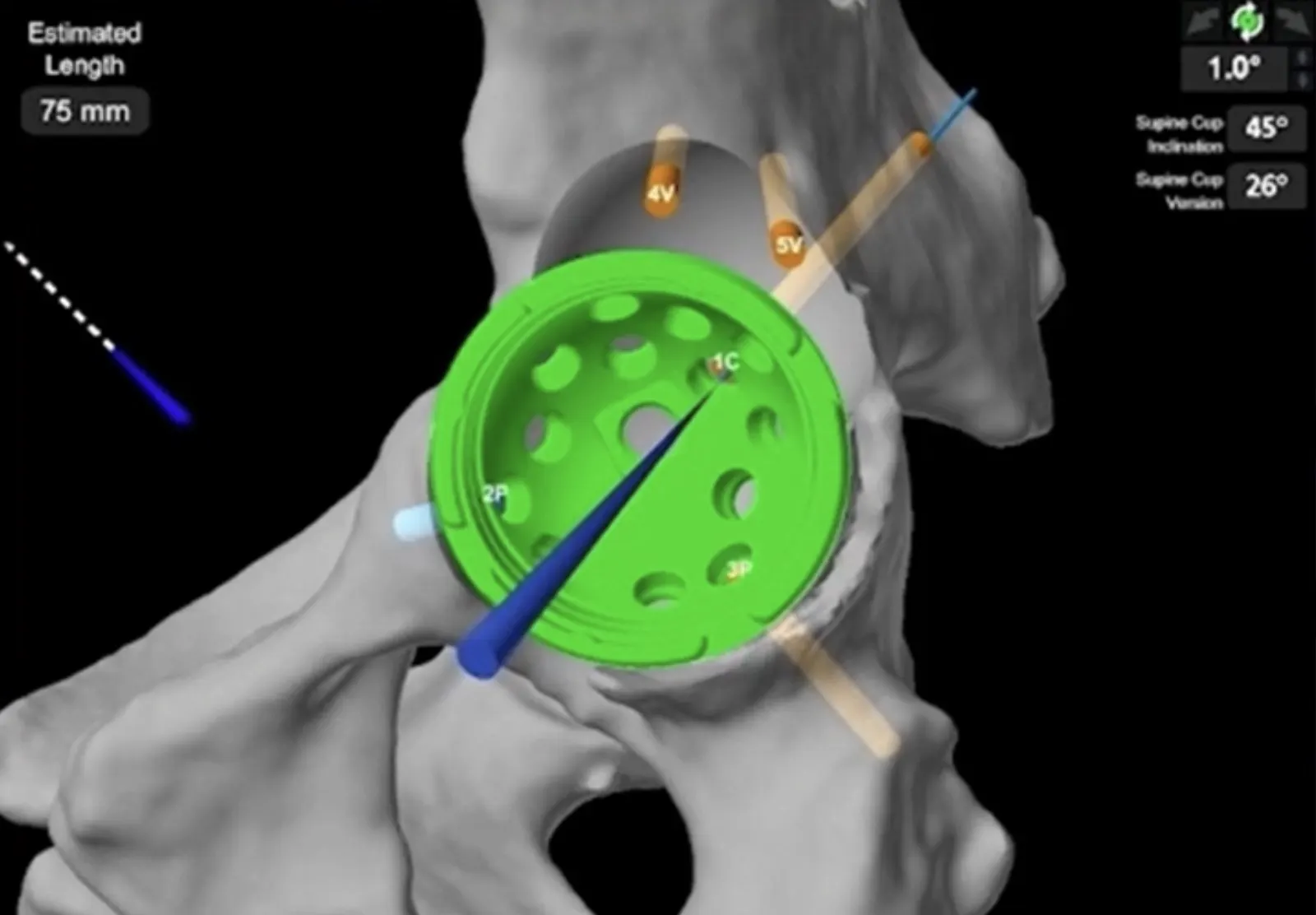
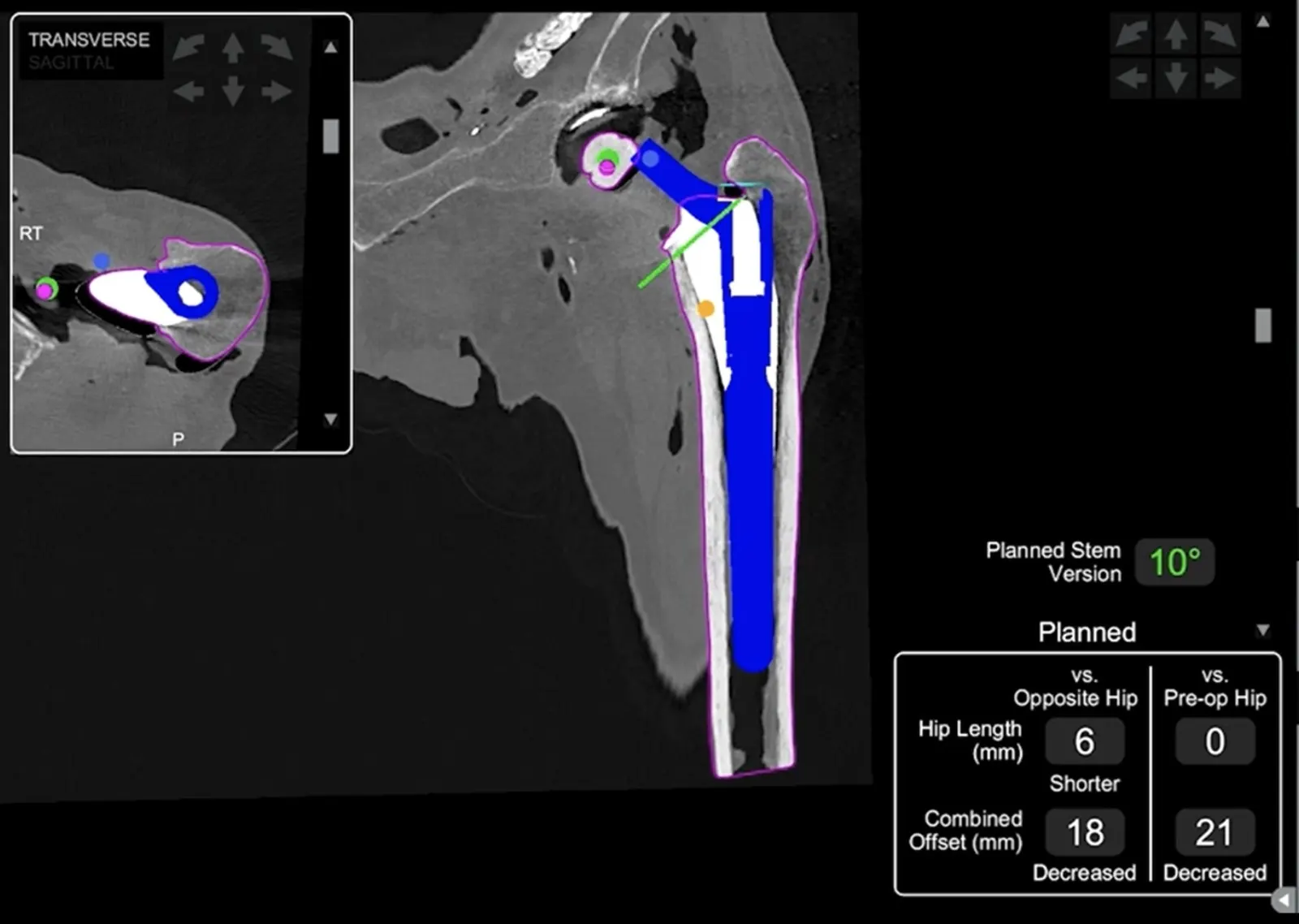
In Mako assisted revision total hip replacement, the existing hip replacement undergoes CT scanning, with standing and sitting X-rays. A virtual revision total hip replacement with functional planning is then performed. This allows the planning of revision socket (acetabular) component size and position with augments. It also allows precise planning of revision socket component screw placement. This ability is valuable, as accurate positioning of these components and restoration of the hip centre of rotation can be a significant challenge in revision hip replacement. The revision femoral stem is also planned. Acetabular socket and femoral stem bone loss or defects can be detected and planned for.
During the surgery, the hip and existing components are mapped in the same way as a primary procedure. The existing components are then removed. The revision socket components, augments and screws are inserted utilising the robotic haptic technology. After femoral preparation, the planned trial revision femoral components are inserted. The definitive femoral components are inserted after probe checking of leg length and offset.
Where infection is present, treatment may involve a staged approach — removal of the implant, placement of an antibiotic spacer, and later reimplantation once the infection has been treated.
What is recovery like?
Recovery varies greatly according to the extent of surgery. Some patients can bear weight immediately, while others need temporary restrictions to protect the bone reconstruction. A longer hospital stay or inpatient rehabilitation may be required.
Strength and mobility generally improve over several months. The plan is individualised and may differ from the standard primary anterior hip protocol.
Rehabilitation after revision hip replacement is individualised rather than protocol-driven, because what is safe depends on the extent of the reconstruction and how the components are fixed. Dr Limbers provides instructions covering weight-bearing, movement and progression at discharge, and those instructions take precedence over any general guide.
View the Anterior Total Hip Replacement Rehabilitation Protocol →
What are the risks?
Infection, dislocation, fracture, blood clots, leg-length difference, nerve or blood vessel injury, ongoing pain, implant loosening and the need for additional surgery. Risks are generally higher than for a first hip replacement.
Revision aims to address a defined cause of implant failure, reduce pain and restore useful function. The likely outcome depends on the reason for revision, bone loss, soft-tissue condition and general health.
Mako planning
How may Mako assist?
Revision hip procedures may be planned using the CT-based Mako platform. The technology can assist with three-dimensional assessment of the pelvis, acetabular bone and existing component position, and may help plan the new socket, screws or augments and assist with robotic-arm controlled preparation of selected areas. Using Mako robotic assistance with increased precision and accuracy had great potential benefits.
Mako is one component of a complex operation. Dr Limbers’ judgement remains central, and not every revision hip procedure is suitable for robotic assistance.
Point of difference
Why Dr Limbers for revision hip replacement.
Revision hip replacement performed within a hip and knee focused practice
Selected use of CT-based robotic planning in revision surgery
Fellowship training at Addenbrooke’s University Hospital, Cambridge, and Cappagh National Orthopaedic Hospital, Dublin
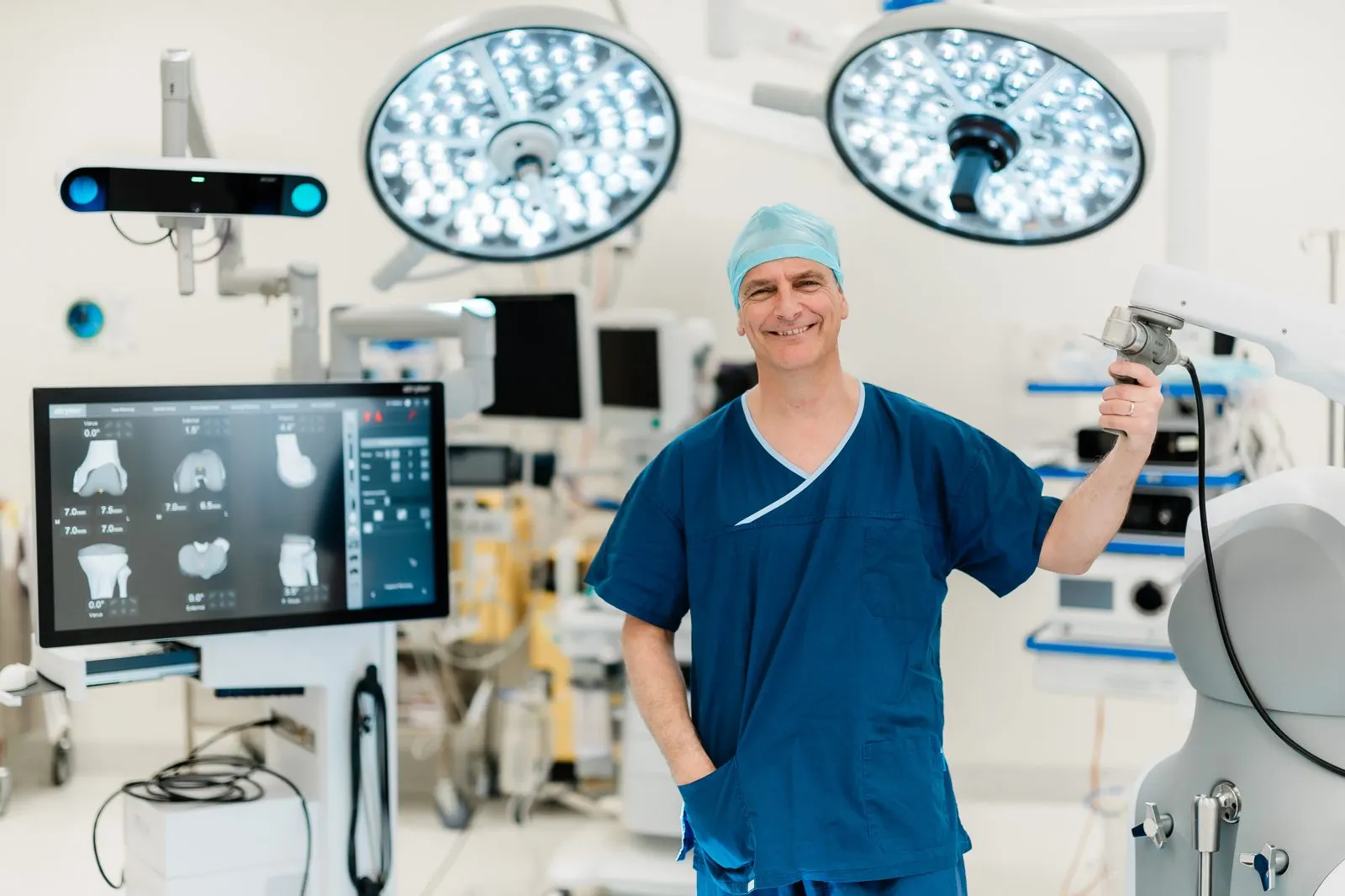
Key orthopaedic surgical experience
Dr Limbers has completed more than 5,000+ hip and knee replacements over a 25+ year career, including more than 3,000+ using Mako robotic-arm assisted technology — one of Australia’s largest individual case series. His fellowship training was undertaken at two international centres where revision hip and knee work is concentrated. Because his practice is confined to hip and knee arthritis and joint replacement, revision work sits alongside a high volume of primary surgery rather than being an occasional undertaking. That matters in revision: recognising why an implant has failed depends on having seen a great many that have not. Dr Limbers accepts referrals for patients who may require revision hip replacement even when the original hip replacement was performed by another surgeon.
Read moreRead less
Common questions
Revision hip replacement, answered.
How do I know if my hip replacement is failing?
New or increasing pain in a hip that had been comfortable, instability, repeated dislocation, a change in leg length, or any wound discharge should be assessed.
Is revision surgery always one operation?
Not always. Where infection is present, treatment may be staged — removing the implant, placing an antibiotic spacer, and reimplanting later once the infection is treated.
Can I have revision surgery if my first hip was done elsewhere?
Yes. Dr Limbers accepts referrals for revision hip replacement where the original hip replacement was performed by another surgeon.
Last reviewed October 2026
Sources3 references
- Australian Orthopaedic Association National Joint Replacement Registry (AOANJRR); Revision procedures: https://aoanjrr.sahmri.com
- Healthdirect; Hip replacement: https://www.healthdirect.gov.au/hip-replacement
- Australian Commission on Safety and Quality in Health Care; Prosthetic joint infection: https://www.safetyandquality.gov.au
Book an Appointment Today
If hip or knee pain is impacting your quality of life, Dr Limbers can assess whether joint replacement or another treatment option is appropriate for you.
Appointments are available at Wahroonga on the North Shore, and at North Gosford and Kanwal on the Central Coast. A current referral is generally requested and allows eligible Medicare patients to claim the relevant rebate.