MAKO ROBOTIC SURGERY
A CT-based plan, executed with precision.
If you have been told you need a hip or knee replacement, you may have come across the term “robotic surgery” and wondered what it actually means — and whether a robot is doing the operation.
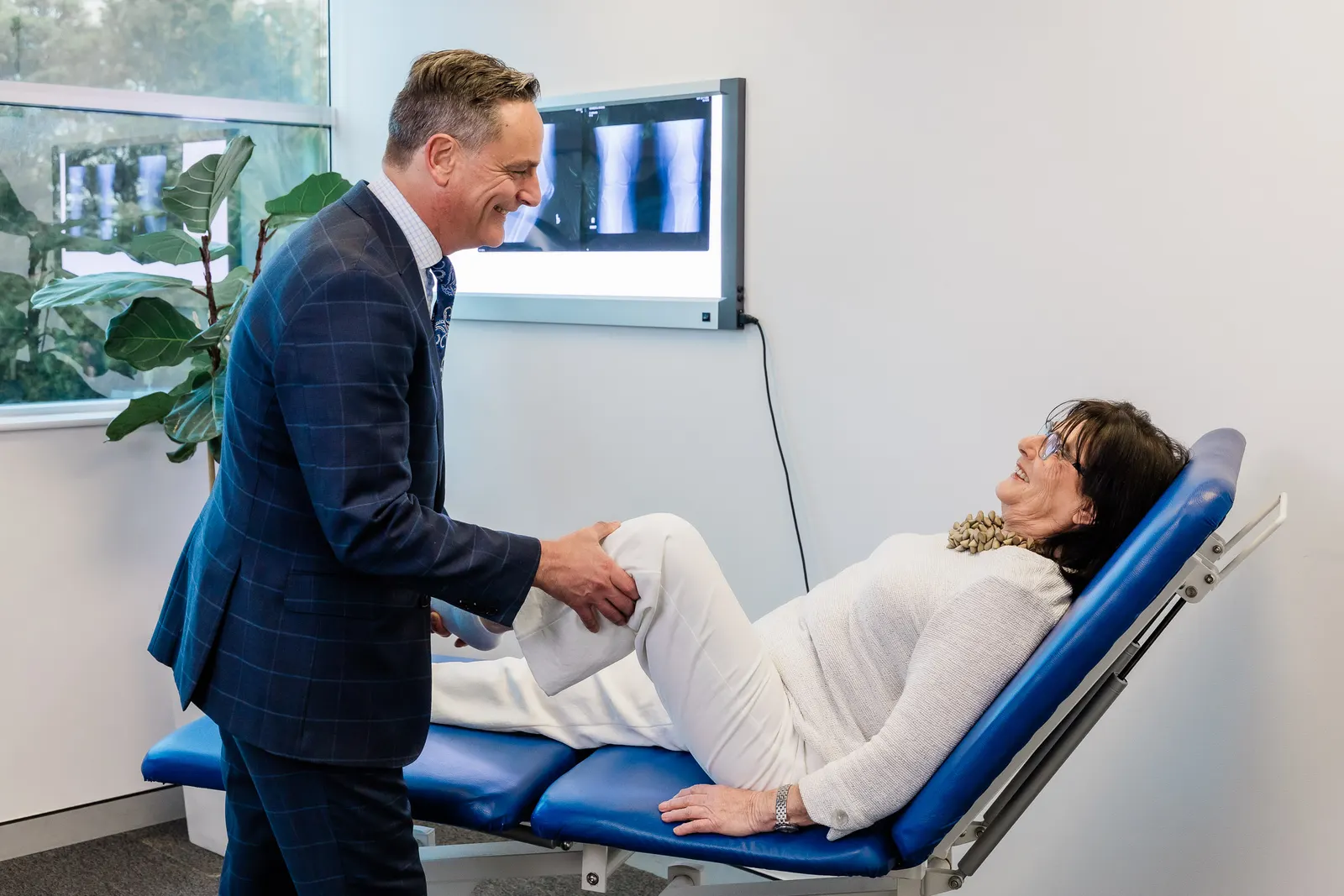
Dr John Limbers
MBBS (Hons 1) · BSc (Med) · FRACS · FAOrthA
Mako Robotic-Arm Assisted Surgery
A surgeon-controlled tool, not an autonomous robot.
It is not. Mako is a form of computer-assisted joint replacement that combines CT-based planning, information gathered during surgery, and a surgeon-controlled robotic arm. Dr John Limbers plans the procedure and controls the robotic arm throughout.
Dr Limbers has performed more than 3,000+ Mako procedures — one of Australia’s largest individual case series — and was the first surgeon in New South Wales to perform a Mako robotic total knee replacement outside pre-release clinical assessments.
How Mako works
How does Mako robotic surgery work?
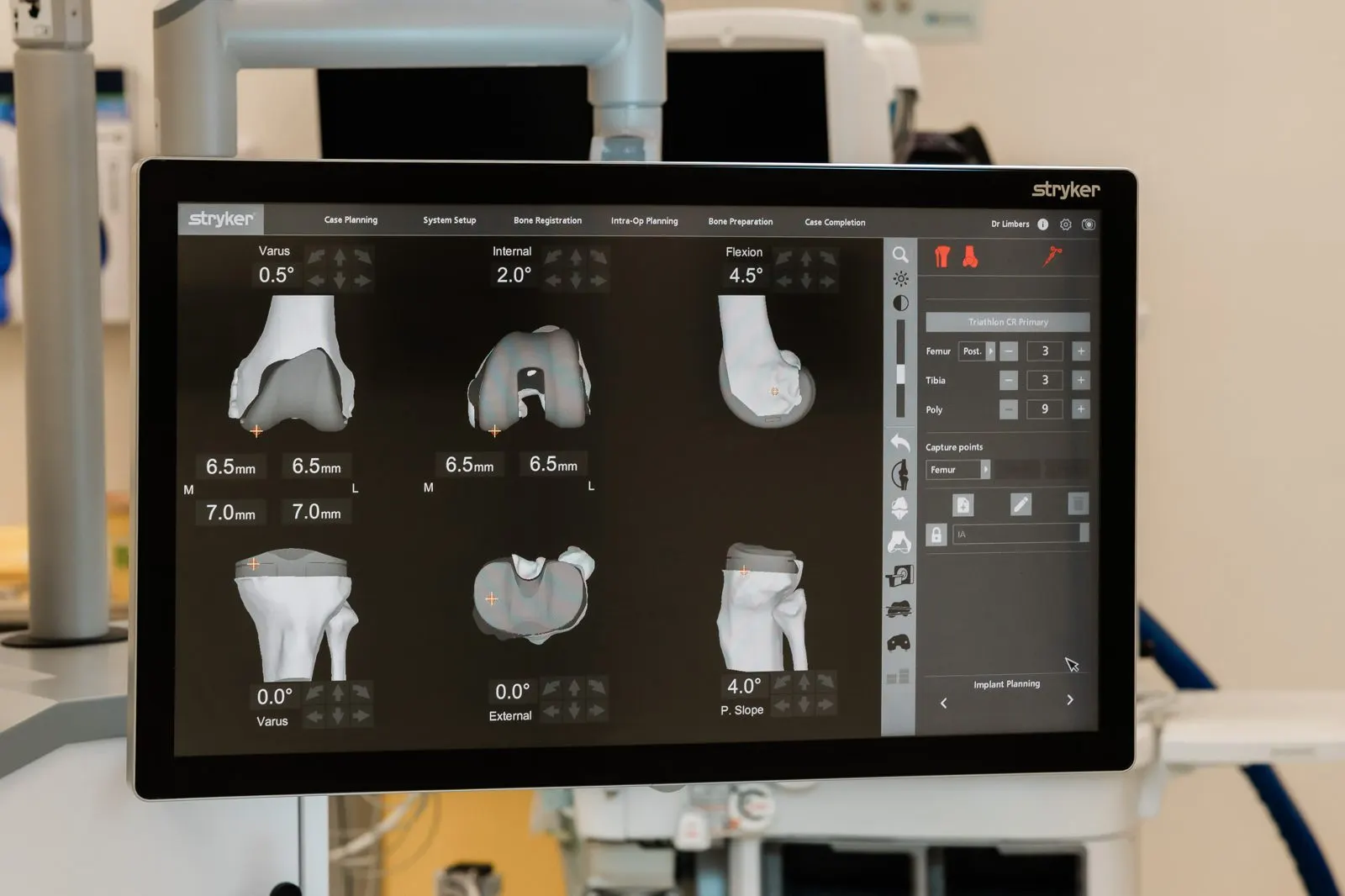
Before surgery, a CT scan using a Mako-specific protocol is used to create a three-dimensional model of the affected joint. The model allows Dr Limbers to assess your anatomy, select proposed implant sizes and positions, and simulate aspects of the operation before entering theatre.
During the procedure, your anatomy is registered to the computer model. The plan can then be checked and adjusted using information gathered during surgery. The robotic arm provides visual, tactile and auditory feedback, and helps constrain bone preparation to the planned area. This is called Haptic Technology.
Patient-specific CT plan
A CT scan builds a three-dimensional model of your joint. Dr Limbers plans implant size, position and alignment before the day of surgery.
Robotic-assisted execution
In theatre, the robotic arm helps him carry out that plan, preparing bone only within the boundaries set in advance.
Checked and balanced
Alignment and soft-tissue balance are assessed and fine-tuned before the implant is fixed in place.
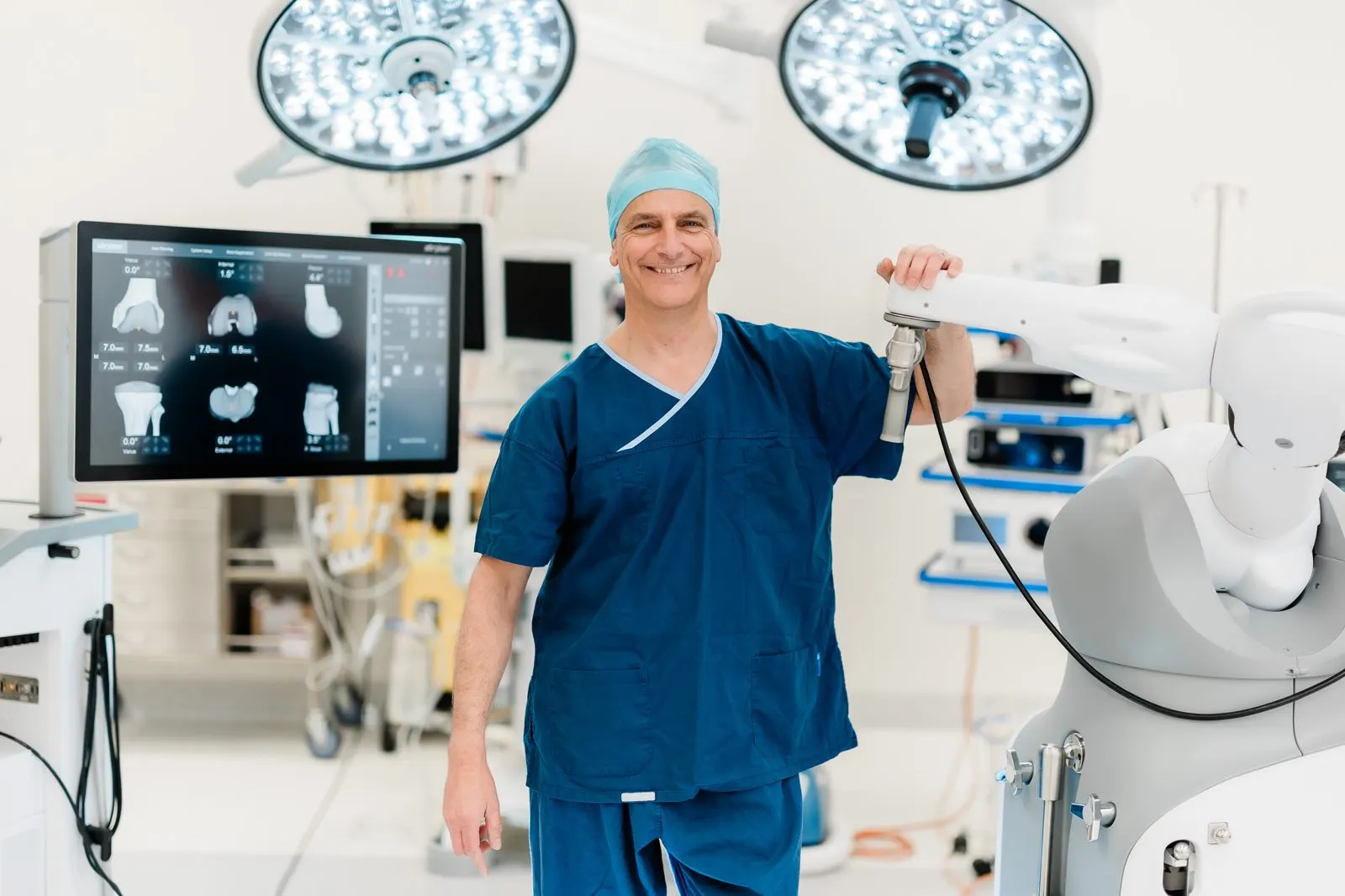
In control throughout
Is the robot performing the surgery?
No. This is the most common misunderstanding, and it is worth being clear about.
Mako is a surgical tool rather than an autonomous robot. Dr Limbers remains responsible for every stage of the operation — patient selection, planning, surgical exposure, bone preparation, soft-tissue management, implant placement and final assessment. The robotic arm does not move on its own and does not make decisions.
The value of the technology therefore depends on both the system and the experience of the surgeon using it. A robotic platform cannot replace clinical judgement or surgical skill.
The advantages
What are the advantages of Mako?
Mako robotic-arm assisted joint surgery offers enhanced surgical precision through three-dimensional virtual anatomical mapping. Compared with traditional manual joint replacement, that precision supports:
More accurate implant alignment, planned in three dimensions and executed to that plan
Preservation of healthy bone and soft tissue, because bone preparation is confined to the planned area
Some studies report less post-operative pain in the early recovery period
Some studies report faster early functional recovery
A patient-specific plan built from your own anatomy rather than from standard instrument sizes
The ability to refine that plan using information gathered during the operation
Assistance with restoring hip biomechanics, or balancing the knee against its own ligaments
Individual results still vary. Recovery and long-term outcome depend on the underlying condition, general health, implant choice, rehabilitation and other individual factors, and no technology changes that.
The evidence
What does the evidence actually show?
Robotic surgery is heavily marketed, so it is useful to separate the established evidence from the questions that remain open. Dr Limbers has direct experience of that evidence as a contributor to the Australian RASKAL trial of robotic-assisted total knee replacement.
What is well established
Robotic assistance improves the accuracy and consistency with which a planned implant position and limb alignment can be reproduced compared with conventional manual instrumentation. Published studies also report differences in early pain, soft-tissue injury and early functional recovery in some patient groups, although the size and clinical importance of these effects varies between studies.
Read moreRead less
What the RASKAL trial found
RASKAL is the Australian registry-nested randomised trial of robotic-assisted surgery and functional alignment in total knee replacement, published in the Bone & Joint Journal. Dr Limbers is a contributor to it.
In RASKAL, robotic-assisted surgery did not produce superior patient-reported or functional outcomes at two years when compared with computer-navigated total knee replacement. It was, however, associated with shorter operating time and better preservation of the posterior cruciate ligament. Functional alignment reduced the need for soft-tissue releases.
Two things are worth understanding about that result. The comparison was against computer navigation, which is itself a technology-assisted technique — not against traditional manual instrumentation. And two years is early in the life of a knee replacement.
Read moreRead less
What is still open
Whether greater surgical accuracy produces measurable differences in long-term function, implant survival or revision rates remains uncertain. This is an important question because hip and knee replacements are expected to function for many years, and longer follow-up is required to assess durability.
Accurate implant positioning remains an important technical objective in joint replacement. Mako provides Dr Limbers with a patient-specific three-dimensional plan and a controlled way to execute that plan during surgery.
Read moreRead less
Conditions & treatments
Which procedures use Mako?
- Mako assisted
Mako Hip Replacement
For total hip replacement, Mako is used to plan the position and size of the components based on your anatomy. Functional planning can also consider changes in pelvic position between standing and sitting, which may be relevant where spinal stiffness alters the way the hip functions.
- Mako assisted
Mako Knee Replacement
For total and partial knee replacement, the CT-based plan is combined with assessment of ligament tension and knee movement. Dr Limbers can refine implant positioning to reflect your anatomy and soft-tissue balance before using the robotic arm to assist with the planned bone preparation.
- Mako assisted
Mako Revision Surgery
Revision joint replacement is performed when an existing hip or knee replacement needs to be removed, repaired or replaced. Selected revision procedures may benefit from CT-based planning and robotic assistance, particularly where anatomy has been altered by the previous operation. Suitability depends on the implant, bone quality, reason for failure and complexity of the case.
How common is joint replacement in Australia?
The Australian Institute of Health and Welfare recorded 53,500 knee replacements and 35,500 hip replacements performed for osteoarthritis in 2021–22. Osteoarthritis is the most common condition leading to hip and knee replacement in Australia.
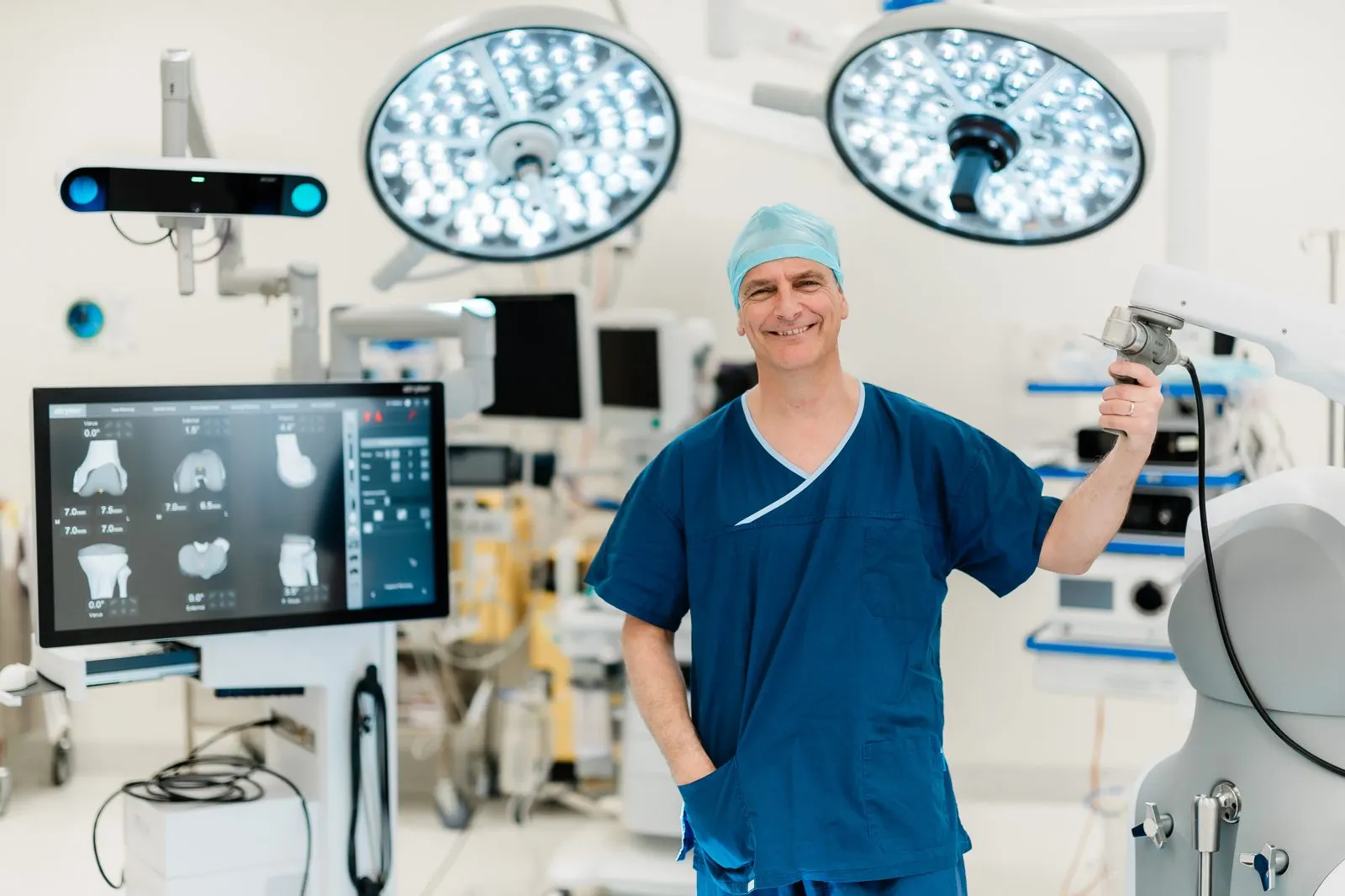
Key orthopaedic surgical experience
Dr Limbers is an accredited robotic surgeon and has used the Mako system since its early availability in Australia. His practice is focused on hip and knee replacement, and robotic assistance is used across the full range of procedures he performs.
Point of difference
Why Dr Limbers for Mako surgery.
More than 3,000+ Mako robotic-assisted hip and knee replacements — one of Australia’s largest individual case series
More than 5,000+ hip and knee replacements over a 25+ year career
First surgeon in New South Wales to perform a Mako robotic total knee replacement outside pre-release clinical assessments
Among the first Australian surgeons to adopt Mako robotic-assisted anterior total hip replacement
Contributor to the RASKAL trial of robotic-assisted knee replacement
Robotic assistance used across primary hip, primary knee, partial knee and selected revision procedures
Common questions
Mako robotic surgery, answered.
Does the robot perform the surgery?
No. Dr Limbers performs the operation and controls the robotic arm at all times.
Does every patient need a CT scan?
Mako planning requires a specific CT scan protocol. The practice will advise which imaging is needed.
Is robotic surgery suitable for everyone?
In most cases. Suitability depends on the diagnosis, anatomy, previous operations, general health and the type of procedure required.
Does robotic surgery remove all surgical risk?
No. All joint replacement surgery carries risks. Robotic assistance supports planning and execution but cannot eliminate complications.
Do I need a robot for my joint replacement?
Joint replacement performed with conventional instruments remains a well-established and effective operation. Mako adds three-dimensional planning and a controlled way to reproduce the surgical plan. Robotic assistance improves the accuracy of implant positioning; whether this translates into better long-term function or implant survival remains under study.
Is the surgeon or the technology more important?
The surgeon. A robotic platform executes a plan; it does not make the plan, select the patient, judge soft-tissue balance or handle the unexpected. This is why case volume matters when you are choosing who performs your surgery — Dr Limbers has completed more than 3,000+ Mako procedures, one of the largest individual series in Australia.
Last reviewed October 2026
Sources4 references
- Australian Orthopaedic Association National Joint Replacement Registry (AOANJRR); Annual Report: https://aoanjrr.sahmri.com
- Australian Institute of Health and Welfare (AIHW); Osteoarthritis: https://www.aihw.gov.au/reports/musculoskeletal-conditions/osteoarthritis
- MacDessi SJ, et al. and the RASKAL Study Group. Robotic-assisted Surgery and Functional Alignment in Total Knee Arthroplasty: The RASKAL Registry Nested 2×2 Factorial Randomized Trial. Bone & Joint Journal. 2026;108-B(5):622–633.
- Healthdirect; Joint replacement surgery: https://www.healthdirect.gov.au
Book an Appointment Today
If hip or knee pain is impacting your quality of life, Dr Limbers can assess whether joint replacement or another treatment option is appropriate for you.
Appointments are available at Wahroonga on the North Shore, and at North Gosford and Kanwal on the Central Coast. A current referral is generally requested and allows eligible Medicare patients to claim the relevant rebate.